Graphs
The notes
Introduction and components
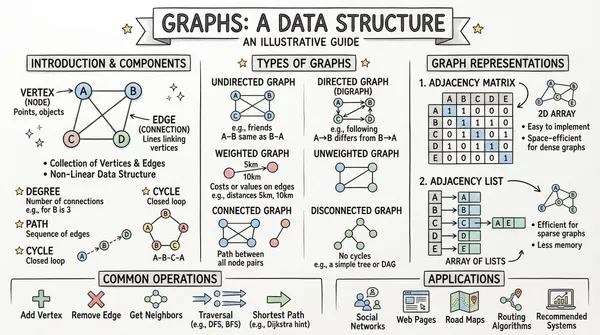
- Vertex (node): points, objects
- Edge (connection): lines linking vertices
- A graph is a collection of vertices and edges
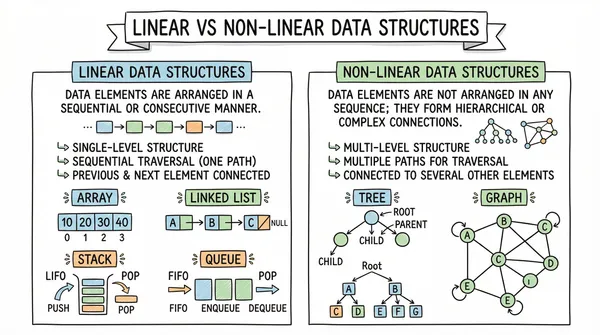
- A graph is a non-linear data structure
- Degree: number of connections, e.g. for B it is 3
- Path: sequence of edges
- Cycle: closed loop (e.g. A-B-C-A)
Types of graphs
- Undirected graph: e.g. friends; A-B is the same as B-A
- Directed graph (digraph): e.g. following; A to B differs from B to A
- Weighted graph: costs or values on edges, e.g. distances 5 km, 10 km
- Unweighted graph: edges carry no values
- Connected graph: there is a path between all node pairs
- Disconnected graph (no cycles, e.g. a simple tree or DAG)
Graph representations
1. Adjacency matrix (2D array)
- Easy to implement
- Space-efficient for dense graphs
2. Adjacency list (array of lists)
- Efficient for sparse graphs
- Less memory
Common operations
- Add vertex
- Remove edge
- Get neighbors
- Traversal (e.g. DFS, BFS)
- Shortest path (e.g. Dijkstra hint)
Applications
- Social networks
- Web pages
- Road maps
- Routing algorithms
- Recommended systems
Data structures deck
Make them stick
Sign in to see every card full size, tick the ones you've got, come back to the rest later, and keep your own notes on each card.
Watch the lesson
 Data structures, Lesson 24