Hashmaps
The notes
What is a hashmap?
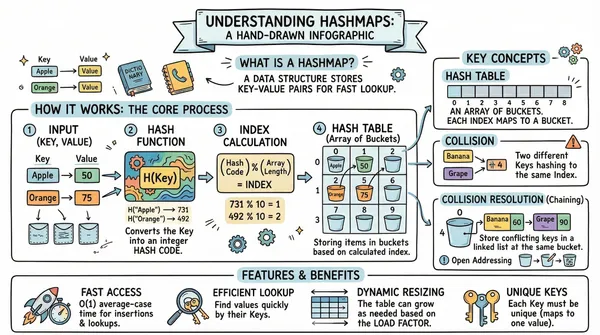
A data structure that stores key-value pairs for fast lookup (like a dictionary or phone book).
How it works: the core process
Steps
- 1. Input (key, value): for example Apple = 50 and Orange = 75
- 2. Hash function, H(key): converts the key into an integer hash code, e.g. H("Apple") gives 731 and H("Orange") gives 492
- 3. Index calculation: (hash code) % (array length) = index, e.g. 731 % 10 = 1 and 492 % 10 = 2
- 4. Hash table (array of buckets): items are stored in buckets based on the calculated index
Key concepts
Hash table
- An array of buckets; each index maps to a bucket
Collision
- Two different keys hashing to the same index (example: Banana and Grape both land on index 4)
Collision resolution
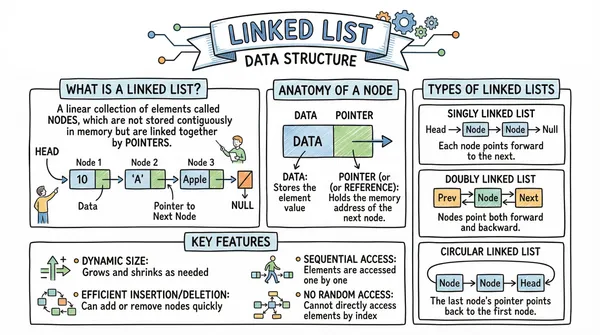
- Chaining: store the conflicting keys in a linked list at the same bucket (example: Banana 60 then Grape 90)
- Open addressing: the other approach named on the card
Features and benefits
- Fast access: O(1) average-case time for insertions and lookups
- Efficient lookup: find values quickly by their keys
- Dynamic resizing: the table can grow as needed based on the load factor
- Unique keys: each key must be unique (maps to one value)
Data structures deck
Make them stick
Sign in to see every card full size, tick the ones you've got, come back to the rest later, and keep your own notes on each card.
Watch the lesson
 Data structures, Lesson 22, from 1:02: Concept Overview