Latency vs throughput
The notes
Latency (time)
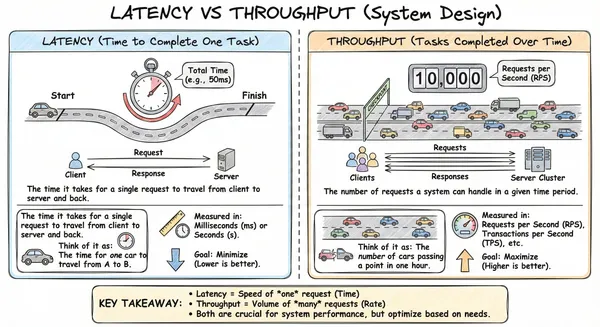
The time it takes for a single request to travel from client to server and back. Measures the speed of individual operations.
What it represents
- Think of latency as the time for one car to drive from point A to point B
- The total duration from when a user clicks a button to when they see the result
- Lower latency means faster, more responsive user experiences
Common causes of high latency
- Network delays, slow database queries, inefficient code, geographical distance between client and server, and lack of caching
Measurement
- Measured in: milliseconds (ms) or seconds (s)
- Goal: minimize (lower is better)
- Example: 50 ms response time for a web page
Throughput (volume)
The number of requests a system can handle in a given time period. Measures the capacity and processing power of the system.
What it represents
- Think of throughput as the number of cars passing through a checkpoint in one hour
- Measures system capacity regardless of individual request speed
- Higher throughput means the system can serve more concurrent users
Factors affecting throughput
- Server capacity, parallel processing capabilities, resource availability and efficient load distribution determine maximum throughput
- Bottlenecks anywhere in the system limit overall throughput
Measurement
- Measured in: requests per second (RPS), transactions per second (TPS)
- Goal: maximize (higher is better)
- Example: 10,000 requests per second
Relationship and trade-offs
Both are crucial, but often require different optimization strategies.
Independent yet related
- You can have low latency with low throughput (fast but limited capacity), or high latency with high throughput (slow per request but handles many)
- Both need optimization
The trade-off
- Optimizing for one may hurt the other
- Adding more concurrent connections increases throughput but may increase latency due to resource contention
- Finding balance is key
Optimization strategies
Reducing latency
- Use caching and CDNs, optimize database queries, minimize network hops, use faster algorithms, and place servers closer to users geographically
Increasing throughput
- Add more servers (horizontal scaling), use load balancers, implement async processing, optimize resource utilization, and use connection pooling
Balance both
- Use efficient architectures like microservices, implement rate limiting to prevent overload, monitor both metrics continuously, and scale based on actual bottlenecks
Prioritize by use case
- Real-time apps (gaming, trading) prioritize latency
- Batch processing and analytics prioritize throughput
- Most apps need both, balanced appropriately
System design deck
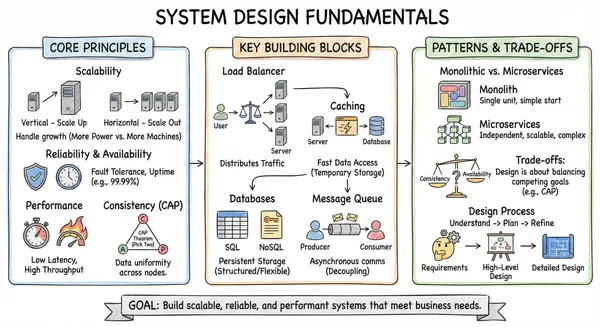 1. Fundamentals
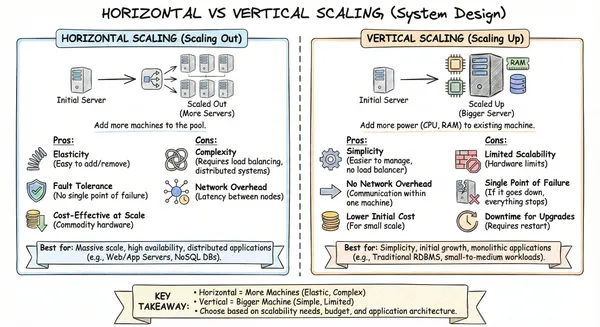 2. Scaling
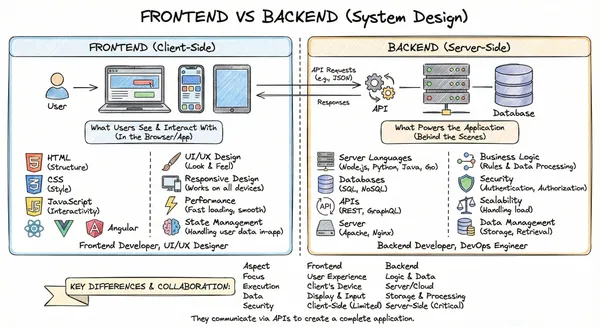 3. Frontend vs backend
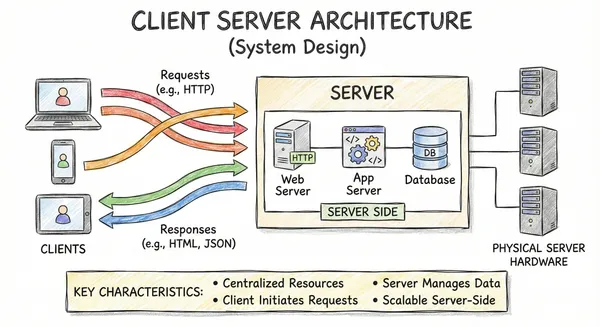 4. Client-server architecture
 5. Databases
 6. Load balancer
 7. Caching
 8. Latency vs throughput
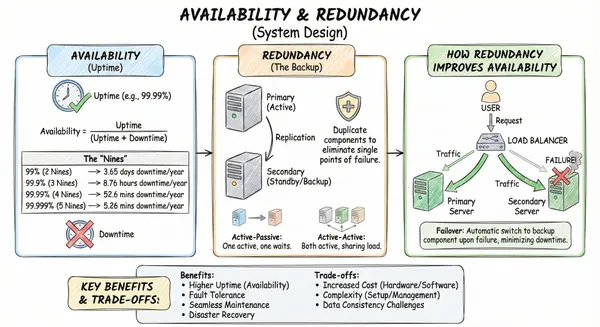 9. Availability and redundancy
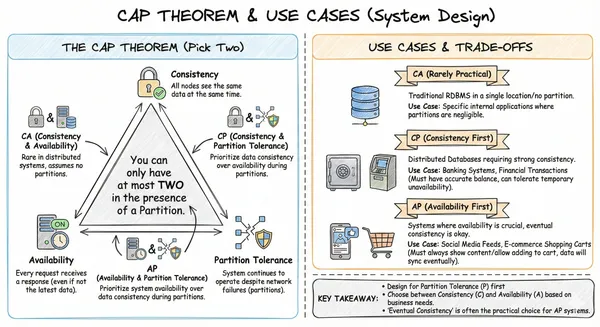 10. CAP theorem
and many more
Make them stick
Sign in to see every card full size, tick the ones you've got, come back to the rest later, and keep your own notes on each card.